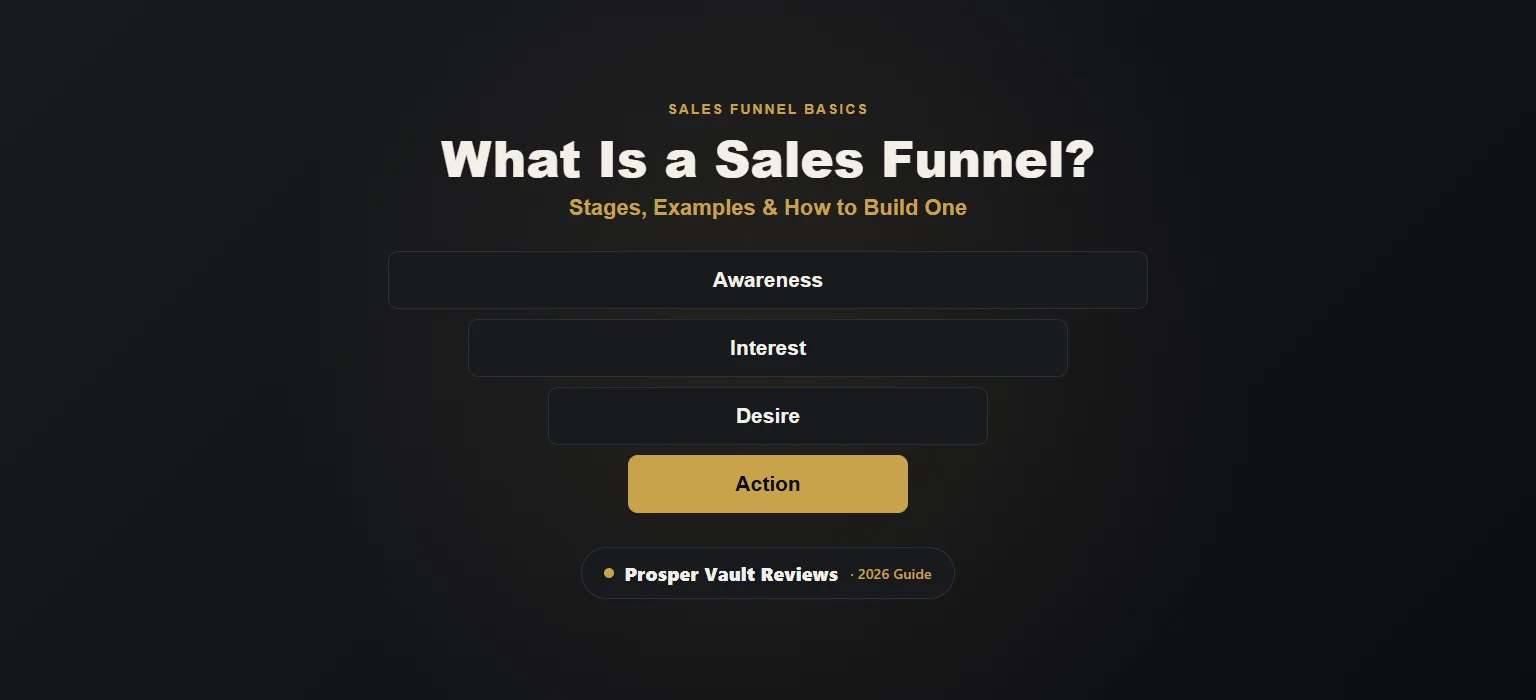
Quick answer: What is a sales funnel? It’s the path a stranger takes from first hearing about your business to becoming a paying customer, mapped as a series of steps where fewer people move forward at each one. A funnel doesn’t create demand, it organizes it, so it only works when the offer and the traffic are right. Here’s how the stages work, what real funnels look like, and how to build a first one without wasting money.
If you’ve searched this, you’ve probably noticed the term means two different things. To some people a funnel is a concept, the path from stranger to customer. To others it’s a piece of software, a “funnel builder” with templates and a monthly bill. Both meanings are common, and they get mixed up constantly.
This guide covers both. First the idea, in plain language, with real examples. Then the books, trainings, and tools I’ve reviewed on this site that people use to build one, so you can see where each fits.
What Is a Sales Funnel?
A sales funnel is a way of picturing every step someone takes between first noticing you and buying from you. It’s shaped like a funnel because many people enter at the top and only a few come out the bottom as customers. Some leave after the first page, some after the third email, and a few buy.
The idea is older than the internet. According to Wikipedia’s entry on the AIDA model, a three-step version of the formula appeared in the trade magazine Printers’ Ink in 1898, and the advertising pioneer E. St. Elmo Lewis is credited with the four-step version he presented in a 1910 speech. The same entry notes that as people move through the stages, the total number of prospects shrinks, which is exactly the funnel shape. So when someone tells you funnels are a new internet invention, that’s the marketing talking, not the history.
What has changed is measurement. Online, you can track every step: how many people saw a page, how many left an email address, and how many bought. That’s what makes a funnel useful. It shows you where people leave.
The Stages of a Sales Funnel
The classic version has four stages, taken from the AIDA model above:
- Awareness (Attention). A stranger finds out you exist, through a search, an ad, a video, a post, or a recommendation.
- Interest. They learn what you offer and whether it fits their situation, often by reading, watching, or joining a free training.
- Desire. They decide they want what you’re offering, usually after seeing proof, getting answers to their doubts, or receiving a few helpful emails.
- Action. They buy, book, or sign up.
Newer versions add stages after the purchase, like retention and referrals, but those four are the core.
Here’s an illustrative example. A coach sells a $2,000 program. A stranger sees a short video (awareness), joins a free live training (interest), gets an email sequence with client stories (desire), and books a call or checks out (action). Every step has a job, and every step loses some people. That’s normal. The goal isn’t to stop the leaks, it’s to know where they are.
What Does a Sales Funnel Look Like?
There’s no single shape, but most online funnels are one of four types:
- Lead magnet funnel. A free guide or checklist in exchange for an email address, followed by an email sequence that leads to an offer. It’s simple and cheap to test.
- Live training funnel. Someone registers for a free session, watches it, and gets an offer at the end, usually with a replay. This is how many high-priced programs are sold. Mark Ling’s Commission Cycle, which I cover in my Commission Cycle review, starts with a free live training before the paid program comes into the picture.
- Book funnel. A physical book offered for the cost of shipping as the first step. Russell Brunson made this format famous, and my DotCom Secrets review covers the book behind one of the best-known examples.
- Free trial funnel. Common with software: a free trial, onboarding emails, and a paid plan after the trial ends. ClickFunnels’ 14-day trial, which the One Funnel Away Challenge requires, is one example.
Which one fits depends mostly on price. A $20 product can sell straight from an ad. A $2,000 program usually needs a warm-up step first, which is why you see so many free trainings sitting in front of expensive offers.
Which Sales Funnels Work Best?
There’s no universally best funnel. The one that works is the one that matches your price and your audience. Here’s my rule of thumb, and it’s just that, not a law:
- Low price (roughly under $50). A short path is enough. A clear sales page, or a free guide followed by a few emails. People will buy a small thing without much convincing.
- Middle price (a few hundred dollars). Add a warm-up. A lead magnet with an email sequence, or a short training, gives people time to trust you before they spend real money.
- High price (thousands of dollars). Expect a longer path. A free live training, a replay, follow-up emails, and often a call or an application before the sale. People need proof and answers, and they need to feel that someone is on the other end.
The mistake I see most is copying a funnel built for a different price. A three-page funnel that sells a $20 ebook won’t sell a $2,000 program, and a five-week email campaign is overkill for a $20 ebook. Pick the shortest path that still gives buyers what they need to say yes.
Do Sales Funnels Really Work?
A funnel is a model, not a machine. It doesn’t create buyers. It organizes the path people already take and makes that path measurable. Whether it works depends on three things: an offer people actually want, traffic from the right audience, and follow-up that doesn’t vanish after the first email.
Here’s where funnels usually fail:
- Sending cold visitors straight to an expensive checkout.
- Putting too many steps between the visitor and the offer.
- Doing nothing after someone leaves their email address.
- Never checking the numbers, so nobody knows which step is broken.
Two numbers tell you most of what you need: the share of visitors who leave their email, and the share of those subscribers who buy. To show how the math works, not as a benchmark, say 1,000 people visit your page and 30% leave an email. That’s 300 subscribers. If 3% of them buy, you have nine customers. If the first number is weak, the page or the traffic is the problem. If the second is weak, the offer or the follow-up is. Change one, measure again, and you know what moved.
How a Value Ladder Fits In
Most funnels aren’t a single offer. They’re steps on a value ladder: a sequence of offers that goes from free or cheap up to your most expensive product, so a customer can move up as trust grows instead of being asked for the biggest purchase up front. In my review, that’s the core idea Russell Brunson lays out in DotCom Secrets, along with the exercise of defining who your ideal customer actually is.
The same logic runs through the high-priced end of the online business world. If you’re curious how it works when the offer at the top is worth thousands of dollars, my guide to high ticket affiliate marketing covers how those sales work and what to check before you pay for any of it.
How to Build a Sales Funnel (Without Overcomplicating It)
You don’t need a ten-page funnel to start. This is the version I’d build first:
- Step 1: Start with one offer and one audience. If you can’t describe who it’s for in a sentence, no funnel will fix that.
- Step 2: Choose an entry point that matches the price. A free guide for a low-priced offer. A free training for an expensive one.
- Step 3: Build the minimum pages. A page to capture the email, a thank-you page, an offer page, and a checkout. That’s it.
- Step 4: Write the follow-up emails. A short sequence that answers the doubts people have before buying. Most sales happen in the follow-up, not on the first page.
- Step 5: Send a little traffic and measure two numbers. The opt-in rate and the buying rate from the example above.
- Step 6: Fix the weakest step first. Not the prettiest one. The one losing the most people.
What to Build It With: Books, Training, and Software
You can build a first funnel with a simple landing page tool and an email service. If you’d rather have pages, email, and checkout in one place, funnel platforms bundle them. Here are the ones I’ve reviewed, in the order I’d use them: learn, practice, build. The buttons below are affiliate links, so I earn a commission if you buy through them, at no extra cost to you.
DotCom Secrets: Learn the Thinking
Russell Brunson’s book on how funnels and value ladders are structured. It’s free, you just cover shipping, and you don’t need ClickFunnels to read it. It’s foundational rather than new, so if you’ve already read similar marketing books, you may not learn much.
Read my full DotCom Secrets review for pricing and what’s included.
One Funnel Away Challenge: Practice
A 30-day guided training where you build your first funnel through daily missions, with two tracks depending on whether you sell information products or physical products. In my review it was a real, structured program, but joining requires a ClickFunnels 14-day trial, which becomes a paid subscription afterward.
Read my full One Funnel Away Challenge review for pricing and what’s included.
ClickFunnels 2.0: Build
An all-in-one platform with funnels, email, courses, community, and a store in one dashboard, and unlimited funnels and visitors on every plan. Plans start at $97 a month, or $81 a month billed annually, according to the vendor’s pricing page at the time of writing. My review notes that the refund and guarantee terms aren’t spelled out in detail on that public page.
Read my full ClickFunnels 2.0 review for what’s inside, and my ClickFunnels pricing guide for what each plan actually costs.
ClickCampaigns.ai by Scale.gg: An AI-First Alternative
Software that turns one marketing objective into a coordinated set of editable assets: emails, ads, landing pages, video scripts, and social posts. It comes from the team behind Groove.cm and it’s brand new under this name, so there’s no long independent track record yet. It has a 30-day money-back guarantee on your first payment, though AI credits are non-refundable.
Read my full ClickCampaigns.ai review for the real pricing tiers, or my comparison of Scale.gg vs ClickFunnels vs GoHighLevel if you’re choosing between platforms.
If you want every Brunson program side by side, my guide to Russell Brunson courses lays them out and shows which ones need ClickFunnels and which don’t.
Common Sales Funnel Mistakes
- Sending cold traffic straight to an expensive offer. Strangers rarely spend thousands of dollars on the first visit. Give them a smaller first step.
- Building ten pages before testing one. Start with the minimum and add steps only when the numbers tell you to.
- No follow-up after the opt-in. Someone who gave you their email is interested. Silence wastes that.
- Tracking sales only. If you only watch purchases, you can’t tell whether the page, the email, or the offer is the problem.
- Overpromising in the copy. If your funnel includes affiliate links, the FTC expects you to disclose them clearly, and earnings claims need real support. My guide to high ticket affiliate marketing explains what that looks like in practice.
FAQ
What is a sales funnel in simple terms?
It’s the path someone takes from first hearing about you to buying from you, broken into steps. Fewer people make it through each step, which is why it’s drawn as a funnel. Its job is to show you where people drop off so you can fix that part.
Do I need a sales funnel to sell online?
Not always. A cheap product can sell from a single page. A funnel starts to matter as the price goes up, or when you want to follow up with people who didn’t buy the first time.
What is the 10-3-1 rule in sales?
It’s a rule of thumb that says roughly 10 leads turn into 3 conversations and 1 sale. I couldn’t find a primary source or a measured benchmark behind it, so treat it as a planning shortcut and measure your own numbers instead.
How much does it cost to build a sales funnel?
It can cost close to nothing if you use a free landing page tool and an email service, or a monthly software subscription if you want everything in one place. ClickFunnels 2.0 plans start at $97 a month according to the vendor’s pricing page at the time of writing. The bigger costs are usually traffic and your own time.
Are sales funnels legal and ethical?
Yes. A funnel is just a structure. What matters is what you claim inside it. The FTC expects affiliate relationships to be disclosed clearly, and its Disclosures 101 guidance says the disclosure has to be hard to miss and placed with the recommendation. Those rules apply inside funnels the same way they apply anywhere else.
A sales funnel is a map of how strangers become customers, and the map is only useful if you look at it. Start with one offer, build the smallest version that works, measure the two numbers that matter, and fix the weakest step first.
This article is for informational purposes only and is not financial, investment, or business advice. Always do your own research and consult a licensed professional before making financial decisions. Some links on this page are affiliate links; see our Affiliate Disclosure for details.